Reviewed by Donna Fuscaldo. The publisher confirms ongoing editorial review.
Prepared with AI-assisted research, writing and design. Sources checked October 3, 2026.
The replacement card can arrive with the same grocery money behind it and a different deadline attached. In Virginia’s chip-card rollout, activating the new card stops the old one. Doing nothing does not keep the old card alive indefinitely: it also stops 60 days after the replacement is mailed.
That makes the date on the state’s record more useful than the date a neighbor received an envelope. Virginia began issuing chip-enabled SNAP EBT cards in September 2026 and says the remaining mailings will run through December. The promised end-of-year completion is a statewide rollout target, not a grace period for every old card. VDSS’s EBT instructions give the two cutoff triggers together.
The practical surprise is that incoming funds and outgoing purchases follow different controls. A locked card can still receive deposits, credits and refunds. An old card can be retired while the benefit account continues. And the new chip card can be activated without the shopper having established that it is unlocked. Those are different questions, even when the first sign of trouble is the same short message at a register.
This guide separates those questions using Virginia’s current instructions. It does not check anyone’s account, determine SNAP eligibility or ask for a card number, PIN or balance. The examples below are teaching examples; selecting an answer changes this article’s explanation, never a real card.
One benefit account. A changing way to reach it.
Choose only what you know. Your answers connect this diagram, the next question and the plan at the end. They do not check or change a real account.
Activation and purchase lock are both unknown. A deposit would not establish either one.
Conceptual diagram, not a card design or account record. Activation retires the old card; the mailing-based cutoff can retire it without activating the new one. A purchase lock does not block deposits, credits or refunds. Sources: VDSS EBT and lock guidance.
The envelope changes the way in, not the money behind it
Fairfax County’s SNAP page expressly says benefits carry over to the new chip card. VDSS says the modernization does not change benefit amounts or issuance schedules. There is no reason to race through the existing balance merely because a replacement arrives.
A useful comparison is a replacement key rather than a second purse. The old and new cards are ways to reach a continuing account; receiving both does not create two balances. The comparison has a limit, though. A physical key still opens a lock until someone changes it. The old EBT card can stop remotely, through activation or the mailing-based cutoff, even while it is still in the wallet.
That distinction also explains why the card envelope is not a substitute for a benefit statement. An envelope tells you a replacement access device has been sent. A transaction record tells you what moved through the account. A case notice explains an agency decision. Put them next to one another if you need to investigate a problem, but do not let one stand in for the other two. Otherwise a familiar-looking card can appear to prove something about the account that it simply does not establish.
Keep any separate SNAP case notice. A renewal, a request for evidence or an eligibility decision is not canceled by the chip-card mailing. If a benefit amount changes at the same time, the card upgrade alone does not explain it. Ask the local agency about the case decision, and the EBT help desk about card access or a transaction. Bringing the right notice to the right conversation is more useful than assuming the two events share a cause.
There is no single statewide old-card expiry day
The state’s rollout page lists 20 pilot localities, with arrivals expected by October 1. Remaining customers are scheduled in phases from October through December. As of this October 3 check, that pilot expectation is already in the past. A pilot household still waiting should ask about its card rather than treating the December statewide target as its own delivery date.
The pilot list is Chesterfield/Colonial Heights, Fairfax City and County, Lynchburg, Madison, Manassas Park, Middlesex, New Kent, Norfolk, Northampton, Orange, Patrick, Portsmouth, Radford, Richmond City, Roanoke City, Smyth, Surry, Warren, Washington and Wythe. Being on the list identifies a rollout phase. It does not establish that a particular envelope was successfully delivered, or on which date that household’s cutoff will fall.
Three dates can be easy to collapse into one: when the state sends a card, when the postal service delivers it and when someone finally opens the envelope. Only the first is named in the main cutoff instruction. A delayed envelope therefore creates a practical reason to act promptly, even if the card feels brand new. It also changes the useful question on a call. Asking for the recorded mailing date and the actual old-card cutoff is more precise than asking how long a new card normally lasts.
There is also a wording difference worth noticing. The main EBT instructions and rollout explanation say 60 days after the new card is mailed; the FAQ and linked English customer flyer say 60 days after it is issued. Neither says 60 days after you open it. This article uses the mailing formulation from the fuller instruction, but does not turn it into a personalized deadline calculator. Ask customer service to confirm the recorded date and actual cutoff. The public pages do not establish a universal time of day for deactivation.
The timeline below compares three fictional households, all mailed a replacement on the same day. One activates on day ten, another on day forty-five, and the third has not activated by day sixty. Their envelopes share a starting point; their old cards do not share an ending point. Delivery is fixed at day seven to make the arithmetic visible: receiving the card leaves 53 days to the mailing-based limit, not a fresh sixty. The third household shows why waiting is not a way to keep both cards usable.
For a routine rollout replacement, VDSS says people who have not received the new card need not make a separate request; they should keep their contact information current. That is different from ignoring a card known to be missing. If the agency says yours was mailed and it has not arrived, or the pilot delivery expectation has passed, explain that specifically when you call. Have the mailing notice available if there is one.
Consider the difference between a card that is still in an announced mailing phase and a card the agency says it already sent. The first is a rollout question; the second may be a delivery problem. A neighbor’s arrival date cannot settle either one. Nor does the December completion target prove that a missing October envelope will be replaced automatically. If a call leaves the situation unresolved, ask what you should do next and when to contact the agency again. Keep that instruction with the notice so another household member can follow it.
A changed address belongs with the local department of social services. Ask how to record a safe mailing arrangement if you are temporarily staying elsewhere; do not assume the address of the place you sleep and the address that should receive mail are always the same. The local-agency directory is the starting point. Record the date, office and next instruction after a call, leaving card credentials out of those ordinary notes.
The same mailing day can produce different old-card endings.
Three fictional comparisons. Lines show only the old-card cutoff rule, not guaranteed purchase access. The delivery date never restarts the clock.
Day 0Delivery
Day 7Mailing limit
Day 60
Old card ends at activation. 50 days before the limit.
Old card ends at activation. 15 days before the limit.
Old card ends at the mailing limit. New card still needs activation.
Days from this example’s delivery to its mailing limit.
Opening the envelope does not add another 60 days.
On example day 7, activation is unknown. The old card’s status cannot be established from the day alone.
Your own mailing date remains unknown to this article. The example does not assign you a cutoff.
Arithmetic illustration, not a personal deadline calculation. VDSS’s main guidance says 60 days after mailing; the FAQ and English flyer say after issuance. Confirm the recorded date and actual cutoff with the help desk. No exact time-of-day rule is inferred.
Activation and unlocking solve different problems
Use the instructions enclosed with the replacement to activate it and establish a new PIN. The old PIN does not transfer. The expiration date and three-digit security code on the new card are used for online purchases and PIN setup or reset. Those details belong in the official process, not in a screenshot posted with a question under an article.
There is a useful stopping point in the setup process: finish one official step and check its confirmation before assuming the next is complete. Having the replacement in your hand is not activation. Remembering the old PIN is not establishing the new one. Seeing the replacement listed in an account is not the same as checking its purchase lock. These are small distinctions when you are at home with time to read; they become much harder to untangle with a basket waiting at a register.
Plan the switch before anyone leaves to shop. In a hypothetical two-adult household, one person activates the replacement at home while the other takes the old card to the grocery store. The balance has not become a second balance or disappeared; the access route changed while the shopper was away. A brief conversation about which card is active can prevent a very public attempt to diagnose that at checkout.
The purchase lock is another control. VDSS’s lock instructions say to choose “Lock My Card Everywhere” in ConnectEBT and confirm. Unlock before a purchase and lock again afterward. A household with multiple EBT cards needs to manage each card’s lock. There is also an unlocking route by phone at 866-281-2448; a smartphone is not the only way to address a locked card.
That direction-of-travel distinction changes what to investigate. Seeing a deposit does not prove a card is unlocked. Unlocking does not activate an unactivated replacement. And replacing a stopped card does not decide a separate case issue. A useful troubleshooting question names the operation: “I can see the deposit, but this purchase is blocked,” rather than concluding that the deposit never arrived.
Virginia’s general instructions warn that five incorrect PIN entries lock the card for the day. That is another reason not to keep guessing when the familiar old PIN fails. Pause and use the official PIN-reset route. The voluntary purchase lock and an incorrect-PIN lock are not interchangeable; changing one setting should not be described as a universal cure for every decline.
A failed tap does not diagnose the account
The chip card supports tapping and inserting. Virginia prefers those methods over the magnetic-stripe fallback. Its FAQ qualifies fallback availability: the retailer must be SNAP-authorized and have properly updated point-of-sale software. A terminal’s contactless symbol, or its ability to accept a bank card, does not by itself establish that its EBT setup is ready. Tell the cashier you are paying with EBT and follow the instructions for that transaction.
Keep the card in your control and shield the PIN entry. If the transaction fails, note the exact message before trying a different route. The word “declined” is an outcome, not a complete explanation. A purchase may involve card status, lock status, PIN entry, retailer support, eligible items and available funds. This article deliberately does not translate an unlocked selection into a green “approved” signal.
A good troubleshooting note records the sequence rather than a theory: which card was presented, which payment method was attempted, the message shown, and whether a completed purchase appears in the official transaction history. You do not need to put a full card number or PIN in that note. If a cashier asks you to retry after an unclear response, first ask whether the earlier attempt completed. A receipt and the transaction record are more useful than reconstructing several attempts from memory later.
Check the receipt before leaving. For a duplicate charge or incorrectly processed voucher, VDSS directs customers to the store manager first, then to the EBT help desk if the problem is unresolved. The agency says those claims are usually resolved within ten business days. That is a description of the usual process, not an individual reimbursement promise or a deadline this article can enforce.
Online shopping adds a separate small budget problem: SNAP does not pay delivery or pickup fees. The state’s chip-card FAQ says an authorized online purchase uses the card number, PIN, expiration date and security code, while fees require another payment method. Before confirming an order, identify the eligible-food total and the non-SNAP total separately. Do not assume that successful card activation also establishes what an online merchant will charge elsewhere.
A failed attempt and a completed charge are different problems.
This is an illustrated troubleshooting slip, not a real receipt or a diagnosis. Choose the observation closest to your question; the call plan below changes with it.
Illustrated check slip · not a transaction record
- Observation
- Preparing to shop
- First useful check
- Establish which card is active; check its purchase lock separately.
- Where to take it
- Virginia EBT help desk for unresolved card questions.
- Not established by this
- A purchase approval, account balance or benefit eligibility.
Read every troubleshooting route
- Tap did not respond: ask the cashier which EBT method the terminal supports. This does not prove an empty balance.
- PIN rejected: stop guessing and use the official new-card PIN/reset instructions. This is not proof of the voluntary purchase lock.
- Purchase declined: keep the exact message; check activation and lock in the official service. A decline alone does not identify the cause.
- Two charges: keep the receipt; start with the store manager, then the help desk if unresolved.
- Unrecognized activity: change the PIN through the official service and call the help desk promptly. Do not assume a reimbursement.
- Benefit-case notice: contact the local social-services agency. A card replacement cannot resolve a case decision.
A stronger card does not make every loss reversible
Virginia describes chip technology as reducing theft risk, not eliminating it. An unsolicited caller can still ask for credentials; a fake message can still claim the new card needs urgent verification. The state’s scam-prevention guidance is a reason to end an unexpected request and independently reach the official service, rather than follow its link or send back a card photo.
ConnectEBT is the app Virginia identifies as approved. Start from the state’s link rather than an advertisement or a lookalike app. Check transaction activity as well as the balance: the balance is a total, while the transaction list can reveal an unfamiliar purchase. If activity is unrecognized, the state instructs customers to change the PIN and call customer service promptly.
The safest response to an urgent message is to choose the route yourself. Put down the incoming message, open the official service from the state page, or call the published help number. That keeps the question of whether the message is genuine separate from the question of whether your account needs attention. A real problem can exist even when a particular text is fraudulent, and a convincing logo cannot make the sender trustworthy. The article’s controls never request credentials, so there is no account-verification step to complete here.
The replacement of a piece of plastic is not the replacement of stolen money. Virginia’s current chip-card FAQ says benefits lost through skimming, cloning or other fraudulent methods cannot be replaced. Fairfax County notes that the replacement program ended December 20, 2024. Do report suspected theft to protect the account and establish what happened, but do not plan the next grocery trip around a reimbursement this article cannot promise. The FAQ separately lists a $4.99 replacement-card charge after a lost chip card; ask the help desk what applies to your situation rather than treating that as a fee to join the routine rollout.
One change coming in November is about the basket
VDSS also announces that, beginning November 1, 2026, sweetened carbonated beverages will no longer be eligible for SNAP purchase in Virginia. As of October 3, that is an upcoming rule. It is separate from whether a chip card has arrived or been activated. Follow the state’s SNAP Healthy beverage guidance for the definitions and implementation details; this article does not classify individual drinks from a product name. The agency FAQ explains that the rule concerns purchases in Virginia, including those made with another state’s EBT card. Purchases elsewhere follow the rules of that state.
The comparison matters because two households can use identical cards and encounter different shopping problems. One may have an old-card cutoff issue in October. Another may have a product-eligibility issue after November 1. Swapping cards cannot make a restricted item eligible, just as taking an eligible item out of the basket cannot activate the replacement. Keep the message, date and item information together when asking what went wrong.
The card clock follows a mailing. The beverage rule follows the calendar.
or 60 days
Old-card cutoff follows the earlier trigger. Your recorded mailing date is not established here.
2026
Upcoming beverage restriction as of October 3. It is separate from chip-card activation.
Changing the card cannot make a restricted item eligible. This figure does not classify products. Consult VDSS SNAP Healthy for beverage definitions and exceptions.
Before the next grocery trip
If food is needed before a card problem can be resolved, pursue help in parallel. Virginia’s food-assistance page links to food-bank resources; 211 can help find local support. Ask the provider about current hours, requirements and availability before traveling. Neither this article nor a successful referral can promise food will be available at a particular place today.
Start with the unresolved fact that could stop the trip. A missing expected card calls for a mailing-status conversation. A card in hand calls for the enclosed activation and new-PIN steps. An activated card calls for checking which card is in the wallet and its current purchase-lock setting. None of those tasks replaces responding to a separate benefit-case notice.
Your next-step plan
Based on: replacement status unknown; purchase lock not checked; preparing to shop.
- Ask the EBT help desk whether the replacement has been mailed or activated.
- Confirm the recorded mailing date and actual old-card cutoff; do not use a neighbor’s delivery date.
- Check the replacement’s purchase lock separately through the official service before shopping.
Virginia EBT help desk: 866-281-2448. Address changes or a benefit-case notice: your local social-services agency.
If you need food before the card issue is resolved: call 211 or use the Virginia food-resource finder; confirm availability with the provider.
No account has been checked. Keep credentials out of ordinary notes and messages.
The plan above is deliberately short enough to use during a call. It brings together the stage you selected and the problem you want help with, rather than asking you to repeat the same story in several separate tools. Its first question is the fact that remains unresolved. Once the official service answers it, you can return and change the selection; the explanation will change with it. Nothing here sends a request, unlocks a card or records your answers for a later visit.
The most useful preparation is modest: identify the active card, establish the new PIN privately, check the lock before shopping and know which office handles the problem if one remains. The new technology is intended to make access safer. Knowing which part of the process is still unresolved makes it easier to keep that access usable.
Sources and limits
Checked October 3, 2026 against the primary pages linked throughout: Virginia DSS’s EBT, chip-card rollout/FAQ, lock/unlock and scam-prevention pages; Fairfax County’s SNAP page; and the local-agency directory. The mailing/issued wording difference is disclosed above. Examples and calculations are ours, not observed household cases. This guide is specific to Virginia’s SNAP EBT transition and does not establish eligibility, a personal mailing date, a future deposit or approval of a purchase.
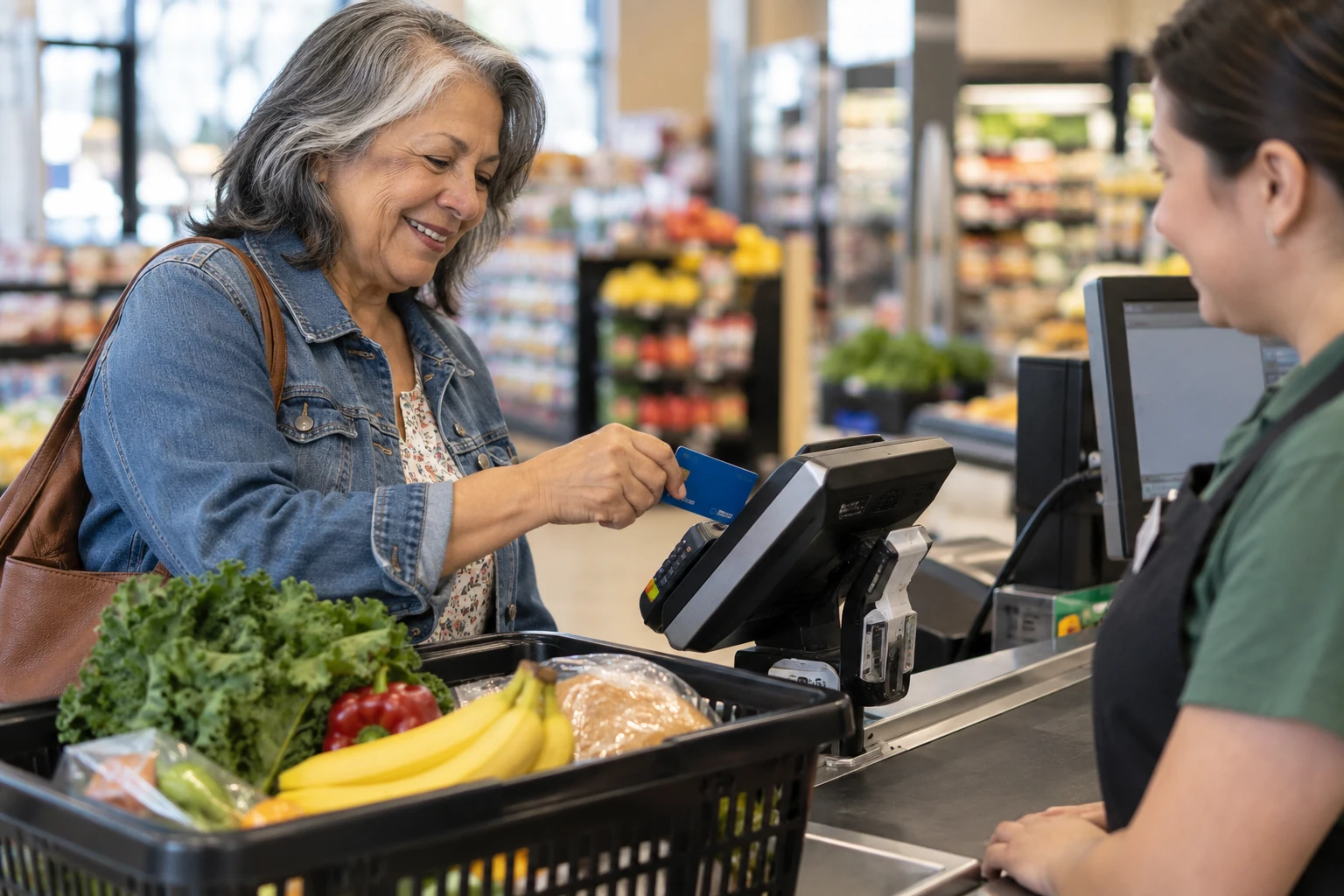
Featured image: AI-generated illustration of a fictional grocery checkout, not a photograph of an actual recipient or agency event.