
Family Georgia benefit missing can feel like a closed door when one income number is all you see.
Lucia’s household has 4 people, including 2 adults and 2 children, and the computed result shows eligibility for SNAP, Medicaid, EITC, CTC, and free school meals.
Her household’s monthly SNAP amount is 969.00. The yearly SNAP figure is 11628.00.
The answer to the question you arrived with is clear: a family of four can qualify for several benefits when household income passes the standard income screen and countable income stays under the net limit.
The figures below use the cited Georgia and federal records, with Services Australia and the DSS appearing in the source set.
Lucia’s example keeps the focus on one household checking who qualifies, how to apply, and what the income rules mean.
Start where you stand
Before the details, map your own situation and see which programs you are likely to qualify for.
See what one approval protects
One approval here can open or steady other programs. See what your decision affects across each one before you change anything.
Straight answer: the rules engine computes about $2,548 a month in combined support for the example household on this page — $969 from SNAP, $610 from EITC, and $415 from Medicaid, plus two smaller programs. Medicaid is health coverage, not money you receive — that figure is what the coverage is worth. EITC is an annual credit shown as a monthly average; it arrives as one payment after you file a tax return. Your own figure depends on your household — every tool below computes it from the same rules.
Family Georgia benefit missing: Lucia’s 4-person household
Lucia’s family is checking one practical question: whether 4 people can qualify for benefits in Georgia and how much the household could receive.
In this case, 2 adults and 2 children make up the household. Its monthly earned income is 2000.00, with 0 in monthly unearned income.
The SNAP calculation records a gross income result of 2000.0 and a net income result of 83.0. Both tests pass in the computed case.
That order matters. The household’s income is under the standard income limit. After deductions, countable income is under the net income limit.
Deductions lower countable income, which sets the size of the benefit. They explain the amount after the income screen, rather than the reason the household passes the standard income limit.
Lucia’s household therefore reaches a computed SNAP amount of 969.00. The annual figure supplied for this example is 11628.
The 7 phrases below track the main decisions a family of four faces while checking eligibility.
Her case gives the straight answer first: the household qualifies for several listed benefits, while other programs return no eligibility in this calculation.
Deductions lower countable income, which sets the size of the benefit.
That’s why most families check the wrong SNAP number.
That distinction helps Lucia read the result without treating rent, utilities, or dependent care as the reason she passed the initial income test.
SNAP income rules for a Georgia family of four
Lucia’s family sees a household income figure and may wonder whether the first screen ends the review.
In this case, the gross test passes because the household income is under the standard income limit.
The computed record gives a published gross limit of 3483.0 for the 4-person household.
The net test also passes after deductions. The recorded net figure is 83.0.
These are separate parts of the same SNAP decision. Household income answers whether the standard income screen is met. Countable income helps determine the benefit amount after deductions.
Lucia’s case includes monthly rent of 1250, utilities of 260, and dependent care of 550. Those figures appear in the calculation as household inputs.
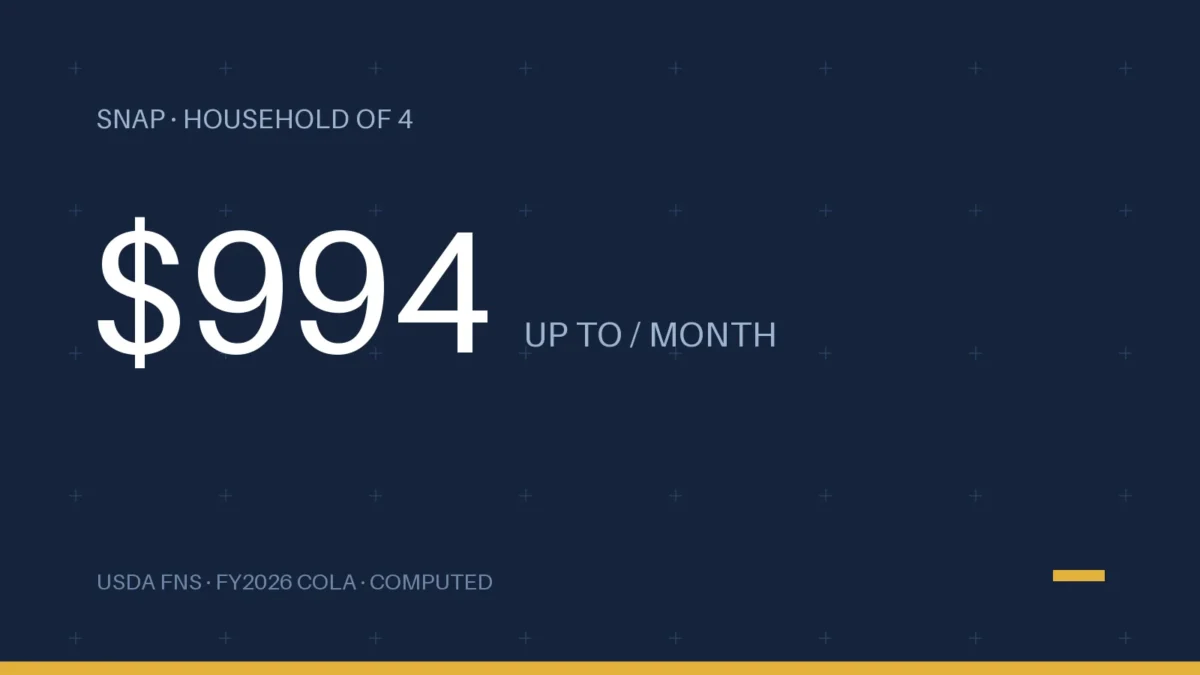
The calculation records shelter excess of 744.0. It also records a contribution of 25 and a maximum allotment of 994.
The final SNAP amount is 969.00. That amount is lower than the maximum allotment because the calculation uses countable income and the recorded contribution.
For families comparing a posted income limit with a benefit estimate, the useful pattern is simple. Passing the income screen and receiving the maximum amount are different outcomes.
Lucia’s household is the example to keep in view. Its income passes the standard test, deductions reduce countable income, and the resulting SNAP amount is 969.00.
The income points supplied for comparison show monthly benefits of 2548.42 at annual income 24000, 3282.36 at 39000, 2064.85 at 54000, and 1888.72 at 60000.
Those comparison points show why one income number cannot answer every family’s question. The benefit picture changes across income levels and programs.
Who qualifies for Medicaid and SNAP in 2026?
Lucia’s household is looking beyond food help because health coverage can change the practical value of the full benefits picture.
The computed result marks Medicaid eligible for the household. Its listed monthly amount is 414.59.
SNAP also appears as eligible, with a monthly amount of 969.00.
These programs sit beside each other in the result, so a family checking only SNAP could miss the health coverage entry.
Eligibility here belongs to the household example already calculated. The result does not say that every Georgia family of four with the same household size receives the same combination.
Income rules differ by program. A family can pass one program’s screen and fail another program’s screen.
Lucia’s record shows that pattern clearly. Medicaid returns eligible, while CHIP and ACA PTC return false in the same calculation.
The listed CHIP amount is 0.00. The listed ACA PTC amount is 0.00.
That result gives the reader a useful checking habit. Read each program separately instead of treating one approval or denial as an answer for every benefit.
Medicaid is part of Lucia’s computed answer because the household result marks it eligible. The amount shown in the result is 414.59 per month.
Pick the household details that match your situation in the eligibility check. The relevant decision is whether your own household result reaches Medicaid, SNAP, both, or neither.
How EITC and CTC add to the benefits picture
Lucia’s family is also checking tax credits because monthly assistance does not capture every benefit in the household result.
The EITC result is eligible, with a listed monthly amount of 609.67. The CTC result is also eligible, with a listed monthly amount of 366.67.
These entries appear alongside SNAP, Medicaid, and school meals. They show why the word benefits covers more than one program type.
The EITC and CTC amounts are separate entries in the computed result. They should not be folded into the SNAP amount when Lucia reads the page.
The household’s 2 children matter to the example because the engine ran a household with 2 adults and 2 children. The result records EITC and CTC eligibility for that household.
Household income remains central to the eligibility picture. The tax credit entries do not change the SNAP causal pathway.
For SNAP, the household first passes the standard income limit. Deductions then lower countable income, and countable income sets the benefit amount.
For Lucia, that pathway ends in 969.00 for SNAP. EITC and CTC remain separate entries with their own listed amounts.
A family checking the full screen can therefore see food help, health coverage, and tax credits in one place.
Each result still needs to be read under its own program name.
Lucia’s five eligible entries create a broader benefits picture than SNAP alone.
The cascade view places CTC, EITC, free school meals, Medicaid, and SNAP in the same benefits picture. For Lucia’s computed case, the combined monthly figure shown is 2548.42.
Free school meals for 2 children in Georgia
Lucia’s household is checking school support because the children’s benefit entry can be easy to overlook beside larger program names.
Free school meals are marked eligible in the computed result. The listed monthly amount is 188.49.
Reduced-price school meals return false, with a listed amount of 0.00. The two school meal entries therefore point in different directions for this household.
The distinction matters when a family sees both program names. The result identifies free school meals as the eligible entry for Lucia’s household.
The school meal amount belongs to that program. It does not change the SNAP amount of 969.00, the Medicaid amount of 414.59, or the tax credit entries.
Families often scan for cash or food support first. School meals can still matter because they meet a separate household need for the 2 children in this example.
The full result gives Lucia five eligible program entries: SNAP, Medicaid, EITC, CTC, and free school meals.
The rest of the listed programs return false in this calculation. Reading the names one by one prevents the household from missing an eligible school benefit.
For Lucia, free school meals belong in the answer to both parts of the question.
The household qualifies for the listed program, and the result gives its amount as 188.49.
The comparison keeps each eligible program and its listed monthly amount separate.
Compare each program name with its eligibility result and listed monthly amount. The table keeps SNAP, Medicaid, EITC, CTC, and free school meals separate.
What benefits are missing from Lucia’s result?
Lucia’s family is also looking at the programs marked false, because a complete check includes the benefits the calculation did not award.
SSI returns false, with a listed amount of 0.00. WIC also returns false, with a listed amount of 0.00.
TANF returns false, and its listed amount is 0.00. ACA PTC and ACP also return false, each with a listed amount of 0.00.
Child care assistance returns false in the result. CDCC and Georgia CDCC each show 0.00.
Other false entries include Lifeline, CHIP, Head Start, Early Head Start, AOC, LLC, Georgia CTC, Georgia SSP, and Georgia TANF.
Those results belong to this computed household. They do not turn into general rules for every family of four in Georgia.
The key point for Lucia is that an ineligible entry does not cancel an eligible one. SNAP remains eligible, and so do Medicaid, EITC, CTC, and free school meals.
A family can therefore have a mixed result. Some programs fit the household record, while others show 0.00.
The missing benefits are part of the answer because they help set expectations.
Lucia’s household should read the result as a program-by-program list, rather than one yes-or-no label.
The figures panel highlights the household size, earned income, gross result, net result, and SNAP amount. It helps keep eligibility and benefit size in their proper places.
How to apply for Georgia benefits in 2026
Lucia’s family is at the point where the computed result needs to become a real application decision.
Georgia’s cited SNAP records identify Georgia Gateway as the application portal for SNAP. The listed address is https://gateway.ga.gov.
The same cited records identify the DFCS Customer Contact Center at (877) 423-4746. Georgia Relay is listed as 800-255-0135.
Those contact details apply to SNAP in Georgia. The records do not establish that one application covers every program in Lucia’s result.
The reader’s practical task is to match each eligible entry with its own application or screening path.
SNAP, Medicaid, EITC, CTC, and free school meals appear as separate program names in the result.
Georgia’s SNAP agency is the Division of Family & Children Services, within the Georgia Department of Human Services. The cited Georgia page identifies that agency as administering SNAP.
For local help, the cited national resource says dialing 211 connects households with local food, housing, and benefits help across the United States, including SNAP application help.
Lucia’s household can use the computed result as a checklist.
SNAP shows 969.00, Medicaid shows 414.59, EITC shows 609.67, CTC shows 366.67, and free school meals shows 188.49.
The application step follows the eligibility reading. The household already has a clear example of what the income rules did and what the benefit calculation produced.
First, a gut check
Before this page hands you the number, take your best guess at the most a household your size could get each month — then see how close you land.
Every household size, at a glance
The table below pairs each household size with its maximum benefit and the income limits that decide who qualifies.
The same ceiling, three ways
The most a household can get moves with its size — here are a few sizes side by side.
The questions behind the questions
What people actually ask once the forms get real.
What this page is — and is not
Read this before you act on any number above.
In the same spirit as the receipts above, here is how the page itself was built, device by device.
If part of your situation reaches past this page, the guides below cover the next step directly.
Which benefits are eligible for Lucia’s household?
Lucia’s household is deciding whether the full benefits result is worth pursuing, and the answer rests on the five eligible entries.
SNAP is eligible at 969.00 per month. Medicaid is eligible at 414.59 per month.
EITC is eligible at 609.67 per month. CTC is eligible at 366.67 per month.
Free school meals are eligible at 188.49 per month. These entries form the household’s computed benefits picture.
The listed monthly total is 2548.42. That figure is supplied by the computation and should be read as the page’s combined monthly result.
Lucia’s annual SNAP figure is 11628. It belongs to SNAP and should not be confused with the combined monthly result.
The household’s eligibility pathway remains the clearest guide. Income under the standard limit lets the household pass the income screen. Deductions lower countable income and set the SNAP amount.
That is why a family can look at the first income number and still misunderstand the final benefit result. The income test and the amount calculation answer different questions.
For this Georgia family of four, the direct answer is yes.
The computed case qualifies for SNAP, Medicaid, EITC, CTC, and free school meals, while the other listed programs return false.
Lucia’s next decision is practical: check the eligible program names, use the Georgia SNAP application path for SNAP, and review each remaining benefit under its own rules.
Lucia is an illustrative composite. Every number in this story was computed by this page’s rules engine or cited from the public record — nothing was estimated by a writer.