
Hannah’s single parent children Oklahoma benefit missing search has a direct answer. Her 3-person Oklahoma household qualifies for 8 modeled programs with a combined monthly value of $3816.09.
That figure includes food, health coverage, tax credits, school meals and early learning support. It does not describe one monthly cash payment.
Hannah has 1 adult and 2 children. Her household reports $1250 in earned monthly income, $0 in unearned monthly income, $1000 rent, $220 utilities and $400 dependent care.
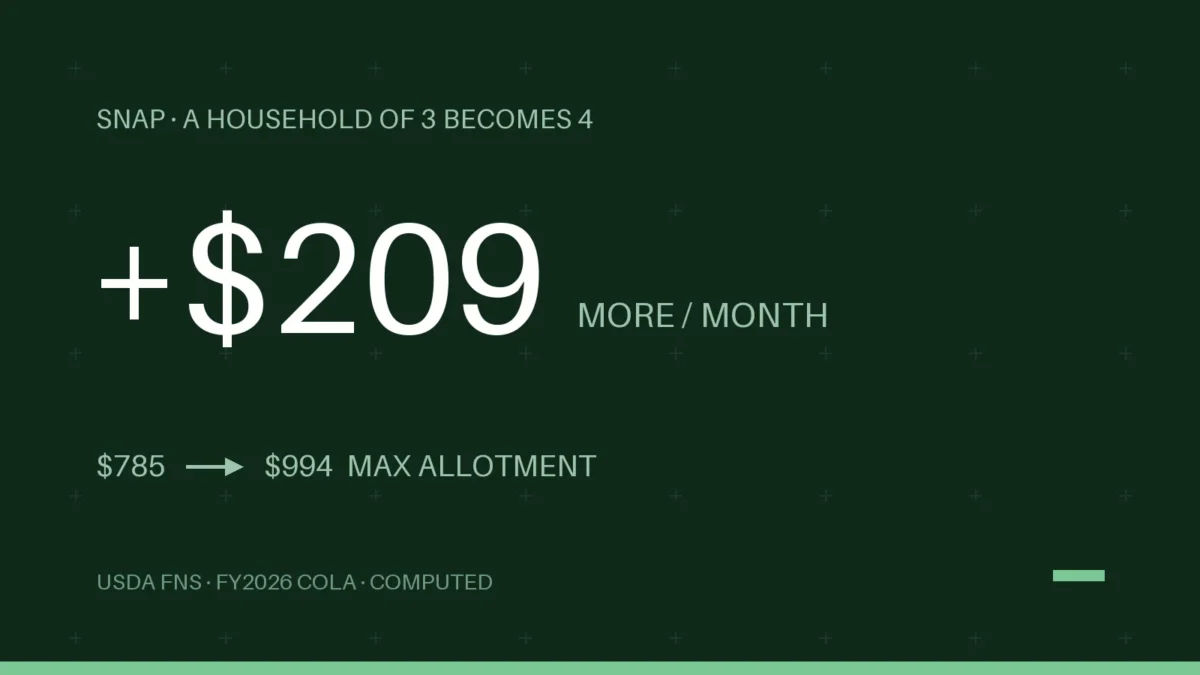
Her SNAP estimate reaches $785 each month, or $9420 for the year. Why can the SNAP amount stay high after the household passes its first income test?
The answer sits in the difference between eligibility and benefit size. The household’s income falls under the standard income limit, while deductions lower countable income and set the benefit amount.
The 2026 SNAP limits come from the USDA. The full estimate then checks each program separately instead of treating one income line as a final answer.
Start where you stand
Before the details, map your own situation and see which programs you are likely to qualify for.
See what one approval protects
One approval here can open or steady other programs. See what your decision affects across each one before you change anything.
Straight answer: the rules engine computes about $3,816 a month in combined support for the example household on this page — $1,101 from Medicaid, $885 from Head Start, and $785 from SNAP, plus five smaller programs. Medicaid and Head Start are health coverage, not money you receive — that figure is what the coverage is worth. Your own figure depends on your household — every tool below computes it from the same rules.
Hannah’s 2026 Oklahoma household estimate
A single Oklahoma parent can see several kinds of support in Hannah’s 2026 household estimate. Her result covers programs with different purposes and eligibility rules.
The modeled household qualifies for SNAP, Medicaid, WIC, EITC, CTC, free school meals, Head Start and Oklahoma EITC. Those 8 results form the combined estimate.
Hannah’s situation remains the same across every check: 3 people, including 1 adult and 2 children. The calculation adds no spouse, job details or ages.
Pick each qualifying line to see how much of the combined estimate comes from food, health, taxes, school meals or early learning support.
Why does SNAP use two income rules?
An Oklahoma parent first faces SNAP’s standard income screen. Hannah’s gross monthly income of 1250.0 falls under the published limit of 2888.0 for her household.
That first result matters because deductions did not get her past the standard income limit. Her household income passed that test before deductions entered the amount calculation.
A second test looks at net countable income. Hannah’s result also passes because countable income reaches 0.0 after the listed deductions.
Both income rules therefore show a pass. Eligibility comes from passing the standard and net tests, while the later benefit calculation uses countable income.
SNAP deductions set the $785 amount
A single parent with housing and dependent care costs can have countable income below gross income. Hannah’s listed deductions lower the income used to set her amount.
The calculation records shelter excess of 744.0 and a contribution of 0. Her maximum allotment equals 785, producing the $785 monthly SNAP estimate.
Those deductions affect benefit size after Hannah clears the income rules. That’s why most families check the wrong SNAP number.
The correct path stays clear: gross income passes the standard limit, countable income passes the net limit, and deductions shape the final benefit.
Single parent children Oklahoma benefit missing: 8 programs
A single parent checking for missing Oklahoma benefits can start with the 8 programs in Hannah’s result. One approval does not describe every other program.
SNAP and WIC address food support in the model. Free school meals add another food-related result tied to the children.
Medicaid represents health coverage value. Head Start represents an early learning service rather than money placed in Hannah’s account.
EITC, CTC and Oklahoma EITC appear as modeled monthly values for tax benefits. Reading each line by program keeps unlike forms of support from blending together.
Follow the qualifying programs in sequence to see how the 8 separate results build Hannah’s combined estimate.
The sequence keeps each program visible while showing how the combined monthly value forms.
What does the $3816.09 total include?
The $3816.09 shown here is not a single payment. Hannah’s total instead combines the modeled monthly value of every qualifying program.
Medicaid contributes $1101.05 to that estimate, while Head Start contributes $884.99. Those entries describe modeled service values rather than monthly cash deposits.
SNAP contributes $785.00, and WIC contributes $59.46. Free school meals add a modeled value of $94.25.
Tax entries include $500.00 for EITC, $366.67 for CTC and $24.67 for Oklahoma EITC.
Their presence in a monthly comparison does not state when a tax benefit arrives.
Medicaid and WIC in the 2026 estimate
A single parent checking health and food support sees both Medicaid and WIC in Hannah’s 2026 estimate. The model marks each program eligible.
Medicaid carries a monthly modeled value of $1101.05. This value contributes to the combined estimate without becoming a cash benefit.
WIC adds $59.46 in monthly modeled value. Its result stands apart from SNAP even though both programs relate to food needs.
Separate program checks matter because eligibility does not move as one block. Hannah’s Medicaid and WIC results come from their own modeled screens.
The benefit lines let the family compare value by program while keeping health coverage, food support and cash-like amounts distinct.
EITC, CTC and Oklahoma EITC values
An Oklahoma parent can have tax benefits in the same estimate as food and health support. Hannah qualifies for EITC, CTC and Oklahoma EITC.
The modeled monthly EITC value reaches $500.00. CTC contributes $366.67, while Oklahoma EITC contributes $24.67.
These entries belong to the combined monthly comparison. The figures do not establish a monthly payment schedule or a filing procedure.
Household income still matters for eligibility, yet each tax result follows its own calculation. Hannah’s qualifying SNAP result alone cannot establish who qualifies for a tax credit.
Treating the three tax values as separate lines gives a clearer picture of the support included in her estimate.
Free school meals and Head Start support
Your result may include support that never appears as cash, especially when you have 2 children. Hannah’s result includes free school meals and Head Start.
Free school meals carry a monthly modeled value of $94.25. Head Start carries $884.99 in the same comparison.
Both values contribute to the $3816.09 total, alongside SNAP, Medicaid, WIC and tax benefits. Their inclusion explains why the combined figure exceeds the cash-like portions.
The estimate marks both programs eligible for this household. It does not add ages or school details beyond the 2 children supplied to the model.
Keeping these service values visible helps Hannah see the full result without treating every line as spendable income.
Why do some programs show $0.00?
A single Oklahoma parent can qualify for several benefits while other lines remain at $0.00. Hannah’s model produces that mixed result.
SSI, TANF, ACA PTC, ACP, CDCC, AOC, reduced-price school meals, Lifeline, CHIP, Early Head Start, LLC and Oklahoma TANF show no modeled benefit.
A $0.00 result means this specific household did not qualify under the calculation. It does not change the 8 positive program results.
Hannah’s details drive these outcomes: household size 3, earned monthly income 1250, unearned monthly income 0 and the listed household expenses.
Changing the household facts could change a result, so the eligibility check belongs to the household being tested.
Household income at $15000, $30000, $45000 and $60000
An Oklahoma parent comparing higher household income can see the modeled benefits change across 4 income points. The pattern does not move by one steady amount.
At $15000 in annual income, modeled monthly benefits equal $3816.09. At $30000, they equal $3654.91.
The estimate changes to $2002.86 at $45000 and $1779.75 at $60000. A cliff marker appears at $45000.
These figures compare the model at the listed income points only. They do not create results for income levels between those points.
Move across the four household income levels to see which modeled benefits remain and where the marked change occurs.
Who qualifies under the 2026 Oklahoma estimate?
A single parent asking who qualifies can compare household facts with Hannah’s 2026 Oklahoma estimate. Her exact result applies to the 3-person case the model ran.
Eligibility follows program-specific income rules. Household income that works for SNAP does not, by itself, prove eligibility for Medicaid, WIC or a tax benefit.
Some programs use a federal poverty level measure. LIHEAP sets maximum income eligibility at the greater of 150% of federal poverty guidelines or 60% of state median income.
That LIHEAP rule does not add a LIHEAP amount to Hannah’s result. Her listed qualifying programs remain the 8 programs calculated for this household.
Check the household details program by program to compare your situation with the modeled eligibility results.
How to apply for SNAP in Oklahoma?
An Oklahoma parent deciding how to apply for SNAP can begin with the official state application listed in the SNAP State Directory of Resources.
Every state runs its own SNAP application. The state directory links to each state’s official application page and information line.
Local help also remains available by dialing 211. That service connects households with food, housing and benefits help, including help applying for SNAP.
Hannah’s estimate gives a screening result rather than an approval. The state application makes the actual eligibility determination using the household information submitted.
For this family, the relevant facts include household size, income, rent, utilities and dependent care costs.
What federal expedited service rules apply to SNAP benefits?
A parent facing very low income or resources may meet a faster SNAP timetable. Federal expedited service rules provide benefits no later than the 7th calendar day after filing.
One route covers gross monthly income under $150 with liquid resources of $100 or less. Hannah’s $1250 earned monthly income does not match that route.
Another route compares combined gross income and liquid resources with monthly rent or mortgage plus the appropriate utility allowance. A separate route covers certain destitute migrant or seasonal farmworkers.
The federal rule controls those expedited tests. Hannah’s standard $785 estimate does not itself establish expedited service.
SNAP resource limits of $3000 and $4500
A single parent checking SNAP may also encounter a resource limit. For FY2026, the cited standard limit for most households reaches $3,000.
Households with a member age 60 or older or a member with a disability have a cited limit of $4,500.
Hannah’s household has no elderly or disabled member in the model.
Her estimate does not list liquid resources, so the $785 result should not be read as a finding about assets.
It records the income and deduction pathway supplied by the calculation.
The resource figures belong to different household categories. Matching the correct category keeps the $3,000 and $4,500 limits from being mixed together.
Who qualifies when an Alaska PFD reaches SSI?
An Oklahoma parent does not use an Alaska-only payment rule to set Hannah’s benefits. Her Oklahoma estimate includes no Permanent Fund Dividend or SSI amount.
A separate SSI rule addresses the Alaska Permanent Fund Dividend. SSI counts that dividend as unearned income during the month received and as a resource if retained.
Alaska APA does not count the PFD as income or a resource. The State of Alaska repays SSA for overpayments caused only by the PFD for up to four months.
That state-specific rule does not alter Hannah’s Oklahoma result.
Her SSI line remains ineligible at $0.00, while SNAP, Medicaid, WIC and the other listed programs form the qualifying estimate.
First, a gut check
Before this page hands you the number, take your best guess at the most a household your size could get each month — then see how close you land.
Every household size, at a glance
The table below pairs each household size with its maximum benefit and the income limits that decide who qualifies.
The same ceiling, three ways
The most a household can get moves with its size — here are a few sizes side by side.
The questions behind the questions
What people actually ask once the forms get real.
What this page is — and is not
Read this before you act on any number above.
In the same spirit as the receipts above, here is how the page itself was built, device by device.
If part of your situation reaches past this page, the guides below cover the next step directly.
Check 2026 eligibility one program at a time
A single parent searching for missing benefits can finish with the same question Hannah brought to the estimate. Eligibility and benefit size require separate answers.
Her household qualifies for 8 modeled programs. The combined value reaches $3816.09 per month, with important differences between food benefits, coverage, tax values and services.
For SNAP, the 1250.0 gross income passes the 2888.0 standard limit. Countable income then reaches 0.0, and deductions set the $785 amount.
These 16 sections point back to one rule: no single income figure settles every program. Hannah’s household facts must meet each program’s eligibility screen.
The clearest next decision starts with the positive results, then checks the official application for each program tied to the household.
Hannah is an illustrative composite. Every number in this story was computed by this page’s rules engine or cited from the public record — nothing was estimated by a writer.