
Working couple children South Carolina benefit missing searches lead to one clear answer for Imani. This household of 2 qualifies for an ACA premium tax credit of $698.41 monthly.
SNAP pays $0.00 because gross monthly income of $3333.0 exceeds the $2292.0 limit. The household also receives $0.00 from the other screened programs.
Which result changes the household budget most? The ACA premium tax credit does, because it stands as the only payable benefit in this check.
The 7 benefit topics here separate income limits, benefit amounts, and programs tied to children.
USDA’s FY2026 SNAP figures also show why a working couple can receive no food payment even when rent and utilities take a large share of income.
Start where you stand
Before the details, map your own situation and see which programs you are likely to qualify for.
See what one approval protects
One approval here can open or steady other programs. See what your decision affects across each one before you change anything.
The seven checks, in order: Working couple children South Carolina benefit missing results in 2026; ACA PTC provides $698.41 each month; SNAP income rules block Imani’s payment; Programs tied to children pay $0.00; Household income changes the ACA PTC amount; How to apply for South Carolina benefits?; When should eligibility be checked again?.
Straight answer: the rules engine computes about $698 a month from ACA premium tax credit for the example household on this page. ACA premium tax credit is an annual credit shown as a monthly average; it arrives as one payment after you file a tax return. Your own figure depends on your household — every tool below computes it from the same rules.
Working couple children South Carolina benefit missing results in 2026
A working couple in South Carolina can face several different eligibility answers at once. Imani’s result includes one payable program and several zero decisions.
The household has 2 people, no children, and earned monthly income of $3333. Unearned monthly income stands at $0.
Imani’s household receives one payable benefit
For Imani, the ACA premium tax credit provides $698.41 each month. The combined monthly amount also equals $698.41 because no other screened benefit pays anything.
That answer keeps eligibility separate from assumptions about working. Earned income can block one program while leaving another program available.
The yearly SNAP amount remains 0. The household’s income is over the income limit. No benefit is payable.
Household costs do not reverse the SNAP income failure
Imani’s working household reports monthly rent of $950 and utilities of $200. Those costs do not move the household through the failed gross income screen.
SNAP records net income of $2457.4 after its calculation. Eligibility already ended when gross income exceeded the published limit.
The qualifying ACA result and zero SNAP result appear together here. That split gives the household its direct answer.
ACA PTC provides $698.41 each month
When food and cash programs return zero, your results may still include help with health coverage. Imani qualifies for the ACA PTC.
The monthly amount comes to $698.41. It accounts for the full $698.41 combined monthly benefit shown for this household.
Here, the payable amount sits beside every program result, making the difference between eligibility and payment easy to see.
ACA eligibility differs from SNAP eligibility
Imani’s couple does not receive one shared answer across all benefits. Each program applies its own eligibility result to the same household information.
The ACA PTC returns an eligible result. SNAP, Medicaid, SSI, WIC, TANF, EITC, and CTC each return an ineligible result.
That pattern matters when the first denial feels final. A zero from one program does not change the separate ACA decision recorded for this household.
The payable amount belongs to health coverage
This working couple’s $698.41 result belongs only to the ACA premium tax credit. It does not represent food assistance, cash aid, or a tax credit tied to children.
The cascade contains only ACA PTC and carries the same $698.41 monthly amount. No second program adds to that figure.
A focused view of that single qualifying program shows where Imani’s support comes from.
SNAP income rules block Imani’s payment
A working couple can pay rent and utilities while still failing the first SNAP income test. Imani’s gross monthly income reaches $3333.0.
The published gross limit for this 2-person case equals $2292.0. Income above that line produces an ineligible result and a benefit of 0.
The gross test fails for the stated reason: income sits over the gross limit. That’s why most families check the wrong SNAP number.
Gross income decides eligibility before deductions
For this South Carolina household, the gross screen answers who qualifies before the amount calculation can produce a payment. Imani fails that screen.
Rent, utilities, and other deductions can affect a SNAP amount after a household passes the income tests. They do not make Imani income-eligible here.
The recorded shelter excess equals 0.0, and the contribution equals 0. Those figures follow the ineligible result rather than creating eligibility.
The maximum allotment does not promise a payment
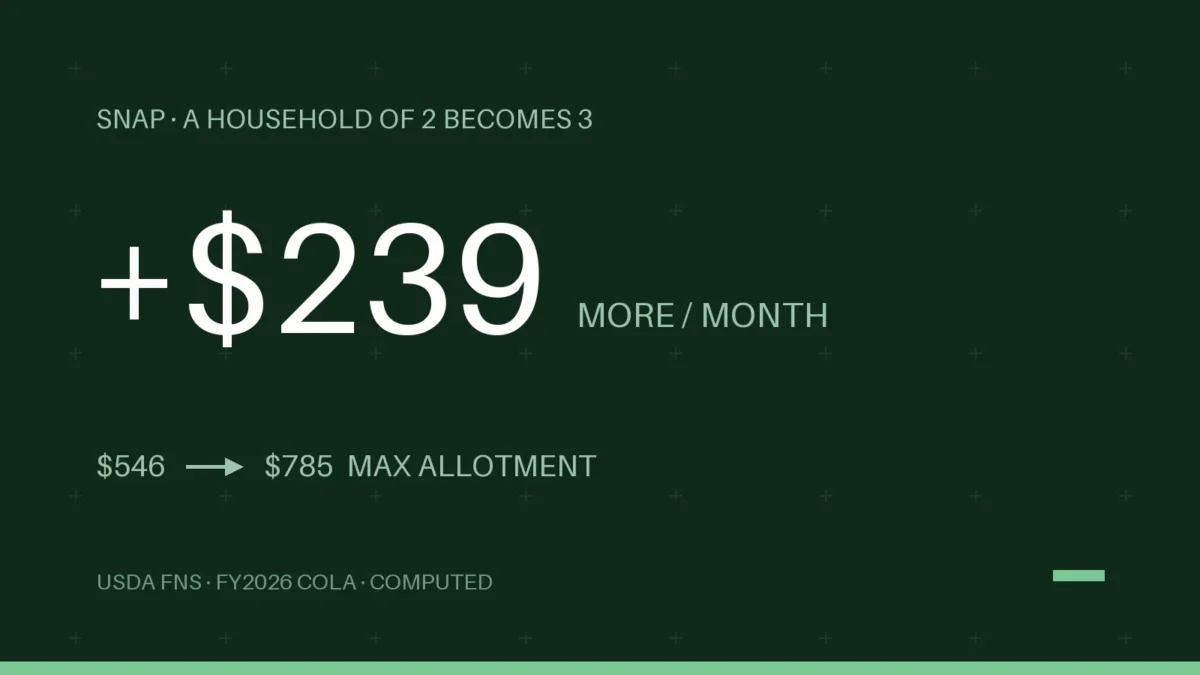
The $546 maximum allotment shown in Imani’s calculation does not guarantee a payment. That maximum does not become the household’s benefit.
Payment depends on passing eligibility rules first. Because gross income exceeds the limit, the final amount stays at 0.
Seeing the full sequence can prevent confusion between a program maximum and a household’s actual result.
The $24 minimum does not apply here
Imani’s couple might also encounter the FY2026 minimum monthly benefit of $24 for households of 1–2 in the 48 states and DC. That rule follows eligibility.
An ineligible household does not receive the minimum. Imani’s failed gross test therefore leads to $0.00 rather than $24.
The minimum helps explain payment size for an eligible small household. It does not override this household’s income result.
Programs tied to children pay $0.00
A working couple with no children will see several child-related programs in a broad benefits check. Imani’s household records no children.
WIC, CTC, CDCC, free school meals, reduced-price school meals, CHIP, Head Start, and Early Head Start each return $0.00.
South Carolina child care programs also return zero, including SC CCAP, SC CDCC, and SC child care subsidies. Those outcomes match the household information used here.
Cash and disability programs also return zero
This South Carolina couple receives no payable result from TANF, SSI, or Medicaid. Each screened amount equals $0.00.
The household record says neither person belongs to the elderly or disabled category used in the calculation. SSI and Medicaid remain ineligible in this result.
TANF and SC TANF also show no payment. The guide does not assign a different reason beyond the recorded eligibility decisions.
Tax credits produce no additional amount
Imani’s working household also checks EITC, SC EITC, CTC, AOC, LLC, and CDCC. Every one returns an ineligible result and $0.00.
No tax-credit amount adds to the monthly total shown here. The ACA premium tax credit remains the only qualifying result.
Program names can sound similar while their rules and purposes differ. Imani’s payable result belongs specifically to ACA coverage help.
Lifeline and ACP add no payment
Your search for help with regular bills may also lead you to check Lifeline and ACP. Both return $0.00 for Imani.
Neither program contributes to the combined monthly amount. The same holds for the screened food, cash, disability, education, and child care programs.
This leaves a simple result: one ACA benefit pays, while the other screened benefits do not.
Household income changes the ACA PTC amount
A working couple’s ACA amount can move as annual income changes. The recorded points show a smaller monthly benefit at each higher income level.
At $28000 in annual income, the monthly benefit equals $698.41. At $43000, it equals $499.97.
The figure falls to $319.74 at $58000 and $303.14 at $60000. These are separate computed points, not a promise of the amount between them.
The income view lets the household see all four recorded points in one place.
The $43000 and $58000 markers show changes
For a working South Carolina couple, the marked annual income points are $43000 and $58000. Both sit on the ACA PTC path.
The monthly amount remains positive at each recorded income, though it declines from the $28000 result. No second benefit appears in the cascade.
A change in household income can therefore alter the ACA result even when SNAP remains outside the payable picture shown for Imani.
Federal poverty level searches require program-specific rules
While checking income rules in South Carolina, you may see the phrase federal poverty level. Each benefit still requires its own stated standard.
For LIHEAP, maximum income eligibility uses the greater of 150% of federal poverty guidelines or 60% of state median income.
That fact does not establish Imani’s LIHEAP eligibility or amount. It shows why one program’s income line cannot replace another program’s decision.
How to apply for South Carolina benefits?
A working couple ready to apply can start with the official state page listed in the SNAP State Directory of Resources. Every state has its own SNAP application.
The directory lists each state agency’s official application page and information line. It provides the relevant path without relying on a portal from another state.
Local benefits help starts with 211
South Carolina residents who want local application help can dial 211. That service connects households with food, housing, and benefits help across the United States.
Its support includes help applying for SNAP. The cited fact does not assign a SNAP payment or change the income rules.
For Imani, an application cannot reverse the stated gross-income failure. The ACA result remains the benefit worth following in the current household check.
Expedited SNAP follows separate income tests
A household facing very low income may qualify for expedited SNAP through any of three routes.
One route requires gross monthly income under $150 and liquid resources of $100 or less.
Another compares gross income and liquid resources with rent or mortgage plus the proper utility allowance.
A separate route covers a destitute migrant or seasonal farmworker with liquid resources of $100 or less.
When one route applies, benefits arrive no later than the 7th calendar day after filing. Imani’s stated gross income does not match the first expedited route.
First, a gut check
Before this page hands you the number, take your best guess at the most a household your size could get each month — then see how close you land.
Every household size, at a glance
The table below pairs each household size with its maximum benefit and the income limits that decide who qualifies.
The same ceiling, three ways
The most a household can get moves with its size — here are a few sizes side by side.
The questions behind the questions
What people actually ask once the forms get real.
What this page is — and is not
Read this before you act on any number above.
In the same spirit as the receipts above, here is how the page itself was built, device by device.
If part of your situation reaches past this page, the guides below cover the next step directly.
Household income changes call for a fresh eligibility check
A working couple’s result can change when household income or household composition changes. The current answer applies to Imani’s recorded 2-person household.
Future income can shift the ACA PTC along the recorded points. A changed household also calls for a fresh check of programs tied to children or disability.
State-specific rules belong to the correct household
A South Carolina couple may encounter benefit rules written for another state. Those rules do not establish eligibility in South Carolina.
For an Alaska household, SSI counts the Alaska Permanent Fund Dividend as unearned income in the month received and as a resource if retained.
APA excludes the PFD from income and resources. Alaska repays SSA for overpayments caused solely by the PFD for up to four months.
That Alaska rule does not alter Imani’s South Carolina result. The relevant payable decision here remains the ACA premium tax credit.
Imani’s current answer remains specific
This working couple qualifies for $698.41 in monthly ACA premium tax credit help. The combined monthly benefit equals the same $698.41.
SNAP pays $0.00 because the household’s income exceeds the gross limit. Deductions do not move the couple past that failed eligibility screen.
Every other screened program also returns $0.00. For the household information given, ACA PTC provides the only benefit Imani could receive.
Imani is an illustrative composite. Every number in this story was computed by this page’s rules engine or cited from the public record — nothing was estimated by a writer.